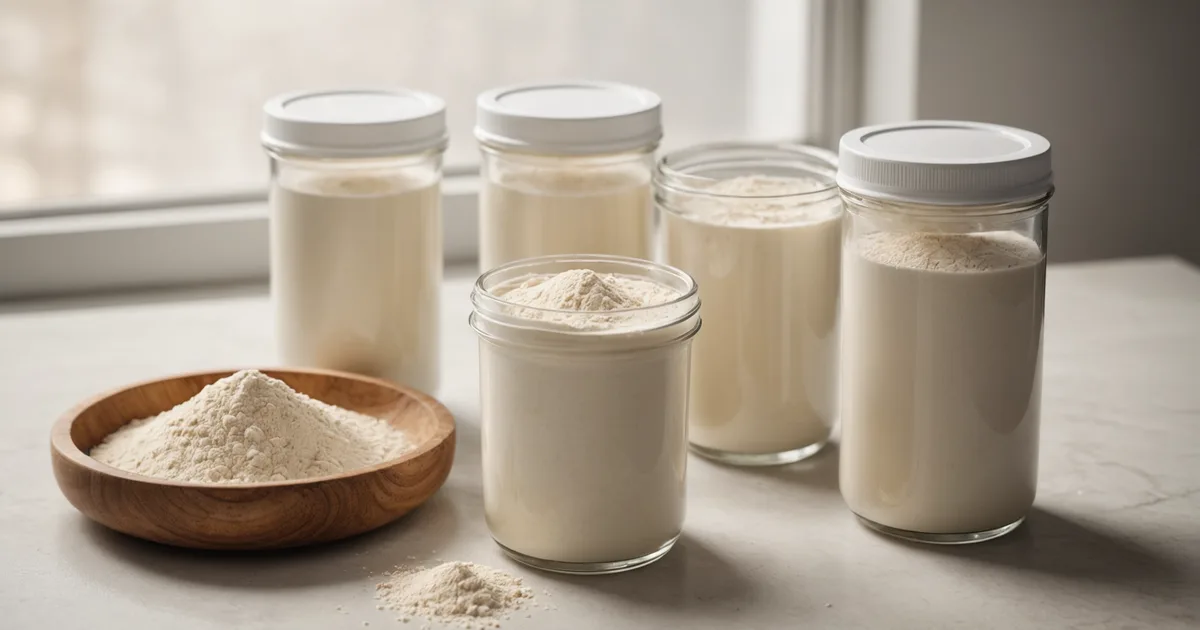
The gap between what food formulators actually need from a whey protein substitute and what the plant-protein industry has shipped in the last decade is not a secret. It shows up in every honest formulation conversation. But it tends to get papered over in ingredient marketing, so it is worth stating plainly: for the functional applications where whey matters most, nothing in the current plant-derived category reliably replaces it.
This piece is not an argument that plant proteins are bad ingredients. They work well in some applications. It is a more specific argument about where the gaps are real and why they persist despite significant industry investment, and where cell-culture approaches like the one we are pursuing at Opalia are positioned to address those gaps.
What formulators actually use whey for
Commercial whey protein concentrate (WPC 80) and whey protein isolate (WPI 90+) are used in food formulations for three distinct functional reasons: heat-induced gelation, emulsification, and foaming. Each places different demands on the protein's structure, and each presents a different substitution challenge.
Heat-induced gelation is where whey's beta-Lactoglobulin fraction earns most of its utility. The protein denatures at around 70 to 80 degrees Celsius and forms disulfide-linked networks through its free cysteine. In a high-protein bar matrix, a protein beverage that gels slightly during thermal processing, or a baked product where protein contributes to final texture, this behavior is what delivers the result. A substitute protein needs the same combination of denaturation temperature, network formation chemistry, and final gel mechanical properties.
Emulsification depends on the rapid adsorption of amphiphilic protein chains to newly created oil-water interfaces during homogenization. Whey proteins adsorb quickly because of specific surface-active regions in their primary structure. The emulsion stability over shelf life depends on the mechanical strength of the adsorbed layer.
Foaming in meringue-type applications and aerated desserts depends on similar adsorption dynamics at air-water interfaces, plus the ability of the adsorbed protein film to resist drainage and coalescence.
Why pea protein fails in these applications
Pea protein, the current default plant substitute for whey in most reformulation projects, presents well in specification sheets because it can be processed to 80 to 90% protein on a dry basis with acceptable amino acid profiles. The functional performance problems are real but less visible to a buyer who is not a food scientist.
The heat-induced gelation problem is structural. Pea protein's main storage proteins, legumin and vicilin, form different intermolecular bonds under heat than whey proteins do. They tend to produce turbid, less cohesive gels with inferior water-holding capacity. The disulfide-bridge-mediated network formation central to beta-Lactoglobulin's gelation behavior is simply absent in pea fractions.
On emulsification, pea protein performs adequately at low oil fractions (below about 10% oil-in-water), but emulsion stability under high-temperature processing and in systems with higher ionic strength, which includes most savory food matrices, is significantly weaker. Droplet size distributions after aggressive homogenization are larger and coalescence rates are higher.
The foaming application is perhaps the most visually obvious failure mode. Pea protein foams collapse faster, have larger bubble sizes, and produce textures that experienced formulators describe as dense or powdery compared to whey. The difference in cream of tartar or inulin addition required to stabilize a pea protein foam versus a whey foam is significant enough to affect sweetness balance and require other recipe changes.
Why the processing solutions have limits
The food ingredient industry has been working on this problem for years and has produced some partial solutions: hydrolyzed pea protein fractions with improved solubility, Maillard-conjugated complexes that improve emulsification, and ultrasound-assisted protein extraction methods that change the protein's surface hydrophobicity. These interventions help, and they represent real progress.
But they are all structural modifications of a protein that is fundamentally not whey. Improving the emulsification of pea legumin through controlled glycation does not give it a free cysteine or a denaturation temperature curve that matches beta-Lactoglobulin. You can move the performance closer to the target in specific tests, but you are doing so by changing the protein, and each change trades off some other property.
Rice protein, faba bean protein, soy protein isolate, and potato protein each have their advocates and their genuine use cases. None of them solve the heat-set gelation problem in a way that allows direct 1:1 substitution in thermally processed formats without recipe reformulation.
Where cell-culture approaches are positioned
The cell-culture production pathway that Opalia uses generates authentic bovine whey fractions: alpha-Lactalbumin and beta-Lactoglobulin from the same mammary cell platform that produces our casein. These are not recombinant proteins expressed in yeast or bacteria. They are the native proteins, with native folding, native post-translational modifications, and native functional behavior.
We are at a pilot production stage. Our current focus is on beta-Casein (BC-1), and our whey fractions are in earlier stage development. We are not claiming that we can supply whey protein alternatives at commercial scale today, because we cannot. Pilot-scale quantities are available for formulation evaluation, and the production economics need further development before we can quote competitive pricing for high-volume applications.
What we are positioned to say is that the path to a whey substitute that actually behaves like whey in gelation, emulsification, and foaming applications runs through authentic protein production, not through further functional modification of plant storage proteins. The performance gap is structural. Cell-culture dairy production is the category most likely to close it.
What formulators should expect in 2026
For most high-volume whey applications, the practical answer in 2026 is still whey protein concentrate or isolate from conventional sources, or a carefully tested partial substitution with plant proteins in applications where the functional gap can be compensated for with other formula changes.
For formulators who are looking 24 to 36 months ahead, the category to watch is cell-cultured dairy proteins at advancing production scales. Pilot quantities are available now from a small number of producers including us, and the data on functional equivalence is accumulating. The question of whether authentically produced whey protein can be cost-competitive with commodity WPC at industrial scale is a production engineering problem that is being worked on, not a biological one.
We run formulation discussions directly with manufacturers evaluating our whey fractions. If you are working on an application where conventional whey is the current gold standard and you want to run a side-by-side evaluation, the conversation starts with describing your specific application and processing conditions. Generic "whey substitute" evaluations miss the specificity of how each whey fraction contributes differently in your format.